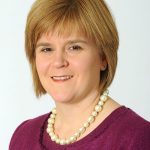
The statement made by Nicola Sturgeon, the Scottish First Minister, on 4 January 2021.
I’m grateful to you, Presiding Office for this recall of Parliament today.
And I want to wish you, members, and everyone watching, all the best for a new year that we hope – despite a very difficult start – will bring better times.
The Cabinet met this morning to assess the up to date Covid situation – which is extremely serious – and discuss what further action is necessary to minimise further spread of the virus. I will set out our decisions shortly.
However, I can confirm now, in summary, that we decided to introduce from midnight tonight for the duration of January, a legal requirement to stay at home except for essential purposes. This is similar to the lockdown of March last year.
However, before I set out Cabinet’s decisions in more detail, I want to explain in some detail why they are so necessary.
In the last few weeks, there have been two significant game changers in our fight against this virus.
One, the approval of vaccines, is hugely positive and offers us the way out of this pandemic.
But the other – the new faster spreading variant of the virus – is a massive blow.
Possibly the most simple way of explaining the challenge we face right now is to compare it to a race.
In one lane we have vaccines – our job is to make sure they can run as fast as possible.
That’s why the government will be doing everything we can to vaccinate people as quickly as possible. I will say more about that later.
But in the other lane is the virus which – as a result of this new variant – has just learned to run much faster and has most definitely picked up pace in the last couple of weeks.
To ensure that the vaccine wins the race, it is essential to speed up vaccination as far as possible.
But to give it the time it needs to get ahead, we must also slow the virus down.
And because it is now spreading faster, that means even tougher restrictions are necessary.
The evidence is now compelling that the new variant is up to 70% more transmissible than previously circulating strains, and that it may add as much as 0.7 to the R number.
And according to recent analysis of PCR test samples, it appears that the new variant already accounts for almost half of all new cases in Scotland.
That increased and faster spread is undoubtedly driving the very serious situation we now face.
Today’s case numbers – 1,905 new cases, with 15% of tests being positive – illustrate the severity and urgency of the situation.
No new deaths were reported today – because yesterday was a Sunday and registration offices were largely closed – but since I updated Parliament before Christmas, 289 deaths have been recorded in the daily figures. That again reminds us of the continuing grief this pandemic is causing.
But this is not just about one day’s numbers.
We are now seeing a steeply rising trend of infections.
Indeed, it is no exaggeration to say that I am more concerned about the situation we face now than I have been at any time since March last year.
In the week from 23 to 30 December, the seven day incidence of cases per 100,000 of the population increased by 65% – from 136 per 100,000 to 225 per 100,000.
Test positivity has risen sharply too.
The next update on the numbers of Covid patients in hospital and intensive care will be published tomorrow.
I would expect these to show that, nationally, the total number of Covid patients in hospital is close to its April peak. And in some boards, the pressure is already very real.
For example, in terms of hospital beds, NHS Ayrshire and Arran is currently at 96% of its Covid capacity, and three other health boards – Borders, Greater Glasgow & Clyde and Lanarkshire – are above 60% of their capacity.
The number of people in intensive care is still significantly lower than the April peak – which partly reflects the fact that treatment of Covid has improved significantly since last spring.
But even so, the total number of patients in intensive care in Scotland is already above normal winter levels. Indeed, all mainland health boards have now exceeded their normal intensive care unit capacity.
And it is important to be clear that people who are in hospital and ICU now are likely to have been infected 10 days to 2 weeks ago.
That means that these numbers reflect what the level of new cases was around 2 weeks ago.
Given that the number of cases has increased significantly since then, we can expect to see significantly increased pressure on the NHS over the course of this month.
Contingency plans remain in place to double and then treble ICU capacity if necessary.
And the NHS Louisa Jordan continues to be available to help meet demand – as indeed it has been doing in recent months. 12,000 patients have attended there for scans and outpatient appointments; nearly 5,000 NHS staff and students have been trained there; and it is currently being used for Covid vaccinations.
In short, NHS services are coping at present – although the pressure on frontline staff is considerable – but already in some areas the position is fragile, and getting more challenging.
And if the rate of increase in case numbers that we have seen in past two weeks was to continue unchecked, there would be a real risk of our NHS being overwhelmed – even with contingency plans in place.
In fact, our modelling suggests that without further intervention, we could breach inpatient Covid capacity within 3 or 4 weeks.
And, of course, a sharply increasing number of cases, in human terms, means many more people becoming ill and dying.
All of that explains why we have to act quickly and decisively.
The situation in some other parts of the UK – where case numbers are already much higher than here, and where the contribution of the new variant is already greater – shows what may lie ahead if we don’t.
As things stand, we estimate that we are possibly about four weeks behind the position in London and the south east.
The rapid acceleration in London began when it was at about 160 new cases a week, for every hundred thousand people. That’s the level Scotland was at a week ago.
London is now seeing 900 new cases a week per 100,000. Test positivity is around 27%. And pressure on NHS services is acute.
We have an opportunity in Scotland to avert the situation here deteriorating to that extent.
But we must act quickly.
The advice of our clinical advisers is clear that the increased transmissibility of the new variant means that the current level 4 measures may not be sufficient to bring the R number back below 1.
It is essential that we further limit interaction between different households to stem the spread and bring the situation back under control, while we vaccinate more people.
In short, we must return for a period to a situation much closer to the lockdown of last March.
Let me therefore set out in more detail the decisions Cabinet has reached.
It is important to stress that these are not decisions taken lightly. I am acutely aware of the impact they will have and I know they will not be welcome.
But they are in our judgment essential.
As government, our clear and overriding duty right now is to act quickly to save lives and protect the NHS.
We know that delay or prevarication in the face of this virus almost always makes things worse not better – even if it stems from an understandable desire that we all share to wait for more data or evidence.
To turn to the decisions in detail. The decisions I will speak about a bit later on schools, let me be clear at this stage, they will apply to all parts of Scotland. However other decisions that I will outline will apply to those parts of Scotland currently at level 4, which of course is all of mainland Scotland, and they are effectively an enhancement to level 4.
The island areas currently in level 3 will remain there for now, although we will continue to monitor them very carefully.
These additional level 4 restrictions – essentially returning us to a position similar to the lockdown of last March – will be in place for the whole of January. We will keep them closely under review.
However, I cannot at this stage rule out keeping them in place longer, nor making further changes. Nothing about this is easy.
The first measure is that our fundamental advice, for everyone, is to stay at home.
That is the single best way of staying safe.
We consider that this stay at home message and advice is now so important that, from tomorrow, it will become law, just as it was in the lockdown last year.
This means it will only be permissible to leave home for an essential purpose.
This will include, for example, caring responsibilities, essential shopping, exercise and being part of an extended household.
In addition, anyone who is able to work from home, must do so. It will only be a reasonable excuse to leave your home to go to work, if that work cannot be done from home.
We are asking people and businesses to take this really seriously – as we all did in March, during the first lockdown, – because the situation is at least as serious now as it was then.
The law already requires many businesses in certain sectors to close in Level 4. We now need every business to look again at their operations, and to make sure that every single function that can be done by people working at home, is being done in that way.
Businesses have already shown a tremendous capacity to adapt during this pandemic and I’m very grateful to them for that – and we need them to consider their operations again, as we all work together to reduce transmissions.
The Economy Secretary will be speaking to business organisations about this, including this afternoon. We will also engage with unions on these issues. And we will continue to consider if more regulatory action is required.
We are also providing new guidance for people who are in the shielding category.
If you were shielding and you cannot work from home, our clear advice now is that you should not go into work at all.
The Chief Medical Officer is writing to everyone who falls into this category, and his letter will count as a Fit Note for those who need it.
Unlike the lockdown last year, the frequency of outdoor exercise is not being limited.
It is important for physical and mental health that we can get outdoors for fresh air and exercise as much as possible.
However, from tomorrow, the rule on outdoor gatherings will change.
As of now, up to six people from two households are able to meet outdoors. Given the greater transmissibility of this new variant, we consider it necessary to restrict that further.
From tomorrow, a maximum of two people from up to two households will be able to meet outdoors.
Children aged 11 and under will not be counted in that limit, and they will also be able to play outdoors in larger groups, including in organized gatherings.
However, for everyone else – including 12 to 17 year olds – outdoor exercise should only take place in a way which is consistent with the 2 people from 2 households rule.
In addition, strict travel restrictions remain in place across Scotland. From tomorrow, if you live in a level 4 area – as the majority of us do – you cannot leave your home except for an essential purpose. When you do go out, stay as close to home as possible and stay away from crowded places.
And it remains the case – and let me stress this point – that no-one is allowed to travel into or out of Scotland unless it is for an essential purpose.
Presiding Officer,
A number of other measures will come into effect on Friday of this week.
It is with real regret that we consider it necessary for places of worship to close during this period for all purposes except broadcasting a service, or conducting a funeral, wedding or civil partnership.
I am well aware of how important communal worship is to people.
But we believe that this restriction is necessary to reduce the risk of transmission.
While up to 20 people will still be able to attend funeral services, wakes will not be possible during January. And a maximum of 5 people will be able to attend wedding and civil partnership services.
Presiding Officer,
I know how devastating restrictions like these are and I give an assurance that we will not keep them in place for longer than is absolutely necessary.
There will also be additional measures in relation to businesses, in addition to the tightening of the essential retail definition that took effect from Boxing Day.
The current 1 metre exemption for workplace canteens will end – so canteens will have to ensure that employees sit 2 metres or more apart, rather than 1 metre.
The number of non-essential services which remain open will be further restricted.
Premises which will need to close as a result of these changes will include, for example ski centres, showrooms of larger retailers, and clinics offering cosmetic and aesthetic procedures.
I know that many businesses have already been hit by the restrictions which were put in place on Boxing Day.
And of course I know that the vast majority of businesses have taken their responsibilities seriously, and have invested in Covid safety measures.
In addition, the move to home working has brought challenges for workers and employers. I am hugely grateful for the way in which businesses and their staff have responded to those challenges.
Grants are of course available for businesses required to close as a result of restrictions. That support is in addition to support through the UK wide furlough scheme.
The Scottish Government’s financial support for businesses during the pandemic currently totals more than £2.3 billion.
However, we will continue to assess what more the Scottish government can do – either in closure grants or other forms of support – to help businesses and those who work for them.
We will also work with councils to ensure community and social support for those who need it, including for parents balancing work and online learning.
We will confirm additional resources later this week.
Presiding Officer,
The final substantive issue I want to address – before giving an update on vaccination – relates to schools.
We announced before Christmas that most school pupils would learn remotely – rather than in school – until Monday 18 January.
I can confirm that we have now decided to extend that date and keep schools closed to the majority of pupils until 1 February. We will review this again in mid-January.
The change will apply to all pupils – except vulnerable children, and children of key workers. And it includes nursery schools, as well as primary and secondary schools.
There is no doubt that of all the difficult decisions we have had to take today, this was the most difficult of all and its impact is of course the most severe.
The evidence to date makes clear that thanks to the hard work of school staff and pupils, schools in Scotland have been low-risk environments for Covid. We will work with our partners to ensure that remains the case.
That will include ongoing work on testing in schools and discussions about when, in the context of the overall programme, it will be possible to vaccinate school staff.
And I want to be clear that it remains our priority to get school buildings open again for all pupils as quickly as possible and then keep them open.
However, right now, two factors mean that it is not consistent with a safety-first approach for all children to attend school in person.
First, the overall level of community transmission is simply too high. We need to get transmission down before schools can safely reopen. A period of online learning will also, in turn, help us do that.
The second reason is that there is still significant uncertainty about the impact of the new variant on transmission amongst young people.
We therefore have to adopt a cautious approach at this stage.
So most pupils will be learning online for at least the rest of the month.
We will review on 18 January whether they can – as we hope – return to school on the 1 February.
I know that remote learning presents significant challenges for teachers, schools, parents and young people, and we will work to support children and parents throughout this.
The Scottish Government, Education Scotland and local authorities are working together to further improve the remote learning options which are available for schools.
And it is also worth highlighting that since schools returned after the summer, more than 50,000 devices – such as laptops – have been distributed to children and young people to help with remote learning. More devices are being distributed by councils on a weekly basis, and in total we expect our investment –which builds on existing local authority action – to benefit around 70,000 disadvantaged children and young people across Scotland.
I also want to stress one final point.
Just as the last places we ever want to close are schools and nurseries – so it is the case that schools and nurseries will be the first places we want to reopen as we re-emerge from this latest lockdown.
They remain our priority.
That is why we are considering whether and to what extent – consistent with our overall duty to vaccinate the most vulnerable first in line with JCVI recommendations – we can achieve vaccination of school and childcare staff as a priority. Many teachers will of course be vaccinated over coming weeks as part of the JCVI priority list.
The fortnightly review will not simply be a choice between opening and closing schools – we will always seek to maximise the number of pupils we can safely get back to classrooms and nurseries.
So if the evidence tells us we can get some pupils back safely, we will do that.
However ultimately, the best way of enabling more pupils to return more quickly is by reducing community transmission of the virus as much as possible.
And all of us – by accepting and abiding by the wider restrictions I have set out today – have a part to play in achieving that.
Before I leave the issue of education, let me remind the chamber that we already had plans in place for the staggered return of universities and colleges. We will be considering this week whether any further change is necessary.
Presiding Officer,
Before I close today, I want to give a brief update on our current expectations around vaccine supply.
The Health Secretary will give a more detailed update on vaccination in a statement the chamber next week.
However, I can confirm today that well over 100,000 people have now received their first dose of the vaccine.
The first doses of the Astra Zeneca vaccine are being administered today.
In total, over the period to the end of January – including the more than 100,000 already administered – we expect to have access to just over 900,000 doses of vaccine. Obviously, we hope that increases.
These will be split roughly equally between the Pfizer and Astra Zeneca vaccines.
However, we anticipate that some of the Astra Zeneca portion will be available only in the last week of January.
We do not yet have certainty on supply schedules beyond January but will keep Parliament updated as these become firmer.
However, our current expectation, based on assumptions about supply and the new advice on doses being administered up to 12 weeks apart, rather than 3, is that by early May everyone over 50, and people under 50 with specific underlying conditions, will have received at least the first dose of vaccine.
That is everyone who is on the JCVI priority list, and comprises more than 2.5 million people.
Once everyone on the priority list has been vaccinated, we will start vaccinating the rest of the population, and will do this in parallel with completing second doses for those on the priority list.
Those timetables are of course heavily dependent on vaccine supply. And for that reason, they are at this stage cautious.
However, I have tasked our vaccination team with exploring and keeping under ongoing review all options to speed up the rate of vaccination and bring these timescales forward as far as possible.
I am grateful for the many offers of assistance we have received and while many of them may not prove possible or practical to take up, they will be considered
The Health Secretary will say more about all of this in her statement next week.
Presiding Officer,
To conclude, this is most certainly not the new year statement I wanted to give.
And I know it is a statement no one wanted to hear.
But as I said at the beginning, we are now in a race between the vaccine and the virus.
The Scottish government will do everything we can to speed up distribution of the vaccine.
But all of us must do everything we can to slow down the spread of the virus.
We can already see – by looking at infection rates elsewhere – some of what could happen here in Scotland if we don’t act.
To prevent that, we need to act immediately and firmly.
For government, that means introducing tough measures – as we have done so today.
And for all of us, it means sticking to the rules
It means continuing to follow the FACTS guidance
And it means – above all – staying at home.
That is again our central message.
Stay Home. Save lives. Protect the NHS.
If we do this, we give the vaccine the time it needs to get ahead and ultimately win the race.
I know that the next few weeks will be incredibly difficult.
I’m sorry to ask for further sacrifices, after nine long months of them. But these sacrifices are necessary.
And the difference between now and last March is that with the help of vaccines, we now have confidence that these sacrifices will pave the way to brighter days ahead.
So – for everyone’s sake and safety – please stick with it and stay at home.