Category: Attack on Ukraine

  • Volodymyr Zelenskyy – 2022 Speech to the Joint Meeting of US Congress

    Volodymyr Zelenskyy – 2022 Speech to the Joint Meeting of US Congress

    The speech made by Volodymyr Zelenskyy, the President of Ukraine, in the United States on 22 December 2022.
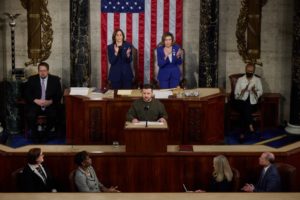
    Dear Americans!

    In all states, cities and communities. All those who value freedom and justice. Who cherish it as strongly, as we, Ukrainians, in all our cities, in each and every family. I hope my words of respect and gratitude resonate in each American heart!

    Madam Vice President, I thank you for your efforts in helping Ukraine! Madam Speaker, you bravely visited Ukraine during the full-fledged war, thank you very much! It is a great honor, a great privilege to be here!

    Dear members of the Congress – representatives of both parties – who also visited Kyiv! Esteemed Congressmen and Senators – from both parties – who will visit Ukraine, I’m sure, in the future! Dear representatives of diaspora – present in this chamber and spread across the country! Dear journalists!

    It’s a great honor for me to be at the U.S. Congress and speak to you and all Americans!

    Against all odds and doom and gloom scenarios, Ukraine did not fall. Ukraine is alive and kicking.

    And it gives me good reason to share with you our first joint victory – we defeated Russia in the battle for minds of the world. We have no fear. Nor should anyone in the world have it.

    Ukrainians gained this victory – and it gives us courage, which inspires the entire world.

    Americans gained this victory – and that’s why you have succeeded in uniting the global community to protect freedom and international law.

    Europeans gained this victory – and that’s why Europe is now stronger and more independent than ever.

    The Russian tyranny has lost control over us and it will never influence our minds again.

    Yet, we have to do whatever it takes to ensure that countries of the Global South also gain such victory.

    I know one more thing – the Russians will stand a chance to be free only when they defeat the Kremlin in their minds.

    Yet, the battle continues! And we have to defeat the Kremlin on the battlefield.

    This battle is not only for the territory – for this or another part of Europe. This battle is not only for life, freedom and security of Ukrainians or any other nation, which Russia attempts to conquer. This struggle will define – in what world our children and grandchildren will live and then – their children and grandchildren. It will define whether it will be a democracy – for Ukrainians and for Americans – for all.

    This battle cannot be frozen or postponed. It cannot be ignored hoping that the ocean or something else will provide a protection.

    From the United States to China, from Europe to Latin America, and from Africa to Australia – the world is too interconnected and interdependent to allow someone to stay aside – and at the same time – to feel safe when such a battle continues.

    Our two nations are Allies in this battle.

    And next year will be a turning point. The point, when Ukrainian courage and American resolve must guarantee the future of our common freedom. The freedom of people, who stand for their values.

    Ladies and Gentlemen!

    Americans!

    Yesterday – before coming here to Washington DC – I was at the frontline, in our Bakhmut. In our stronghold in the East of Ukraine – in the Donbas.

    The Russian military and mercenaries have been attacking Bakhmut non-stop since May. They have been attacking it day and night. But Bakhmut stands.

    Last year seventy thousand people lived there in Bakhmut and now only few civilians stay.

    Every inch of that land is soaked in blood. Roaring guns sound every hour. Trenches in the Donbas change hands several times a day in fierce combat and even hand fighting. But the Ukrainian Donbas stands.

    Russians use everything they have against Bakhmut and our other beautiful cities.

    The occupiers have a significant advantage in artillery. They have an advantage in ammunition. They have much more missiles and planes than we ever had.

    But our Defense Forces stand. And we all are proud of them.

    The Russian tactic is primitive. They burn down and destroy everything they see. They sent thugs to the frontlines. They sent convicts to the war…

    They threw everything against us – similar to the other tyranny, which in the Battle of the Bulge threw everything it had against the free world. Just like the brave American soldiers, which held their lines and fought back Hitler’s forces during the Christmas of 1944, brave Ukrainian soldiers are doing the same to Putin’s forces this Christmas. Ukraine holds its lines and will never surrender!

    So, here is the frontline – the tyranny, which has no lack of cruelty – against the lives of free people.

    And your support is crucial – not just to stand in such fights, but to get to the turning point. To win on the battlefield.

    We have artillery. Yes. Thank you. Is it enough? Honestly, not really. To ensure Bakhmut is not just a stronghold that holds back the Russian army – but for the Russian army to completely pull out – more cannons and shells are needed.

    If so, just like the battle of Saratoga, the fight for Bakhmut will change the trajectory of our war for independence and freedom.

    If your «Patriots» stop the Russian terror against our cities, it will let Ukrainian patriots work to the full to defend our freedom.

    When Russia cannot reach our cities by its artillery, it tries to destroy them with missile attacks. More than that, Russia found an Ally in its genocidal policy – Iran.

    Iranian deadly drones, sent to Russia in hundreds, became a threat to our critical infrastructure. That is how one terrorist has found the other. It is just a matter of time – when they will strike against your other allies, if we do not stop them now. We must do it!

    I believe there should be no taboos between us in our alliance. Ukraine never asked the American soldiers to fight on our land instead of us. I assure you that Ukrainian soldiers can perfectly operate American tanks and planes themselves.

    Financial assistance is also critically important. And I would like to thank you for both, financial packages you have already provided us with, and the ones you may be willing to decide on. Your money is not charity. It’s an investment in the global security and democracy that we handle in the most responsible way.

    Russia could stop its aggression if it wanted to, but you can speed up our victory. I know it.

    And it will prove to any potential aggressor that no one can succeed in breaking national borders, committing atrocities and reigning over people against their will.

    It would be naive to wait for steps towards peace from Russia – which enjoys being a terrorist state. Russians are still poisoned by the Kremlin.

    The restoration of international legal order is our joint task. We need peace. Ukraine has already offered proposals, which I just discussed with President Biden – our Peace Formula.

    Ten points, which should and must be implemented for our joint security – guaranteed for decades ahead.

    And the Summit, which can be held.

    I am glad to stress that President Biden supported our peace initiative today. Each of you, ladies and gentlemen, can assist in its implementation – to ensure that America’s leadership remains solid, bicameral and bipartisan.

    You can strengthen sanctions to make Russia feel how ruinous its aggression truly is.

    It is in your power to help us bring to justice everyone, who started this unprovoked and criminal war. Let’s do it!

    Let the terrorist state be held responsible for its terror and aggression, and compensate all losses done by this war.

    Let the world see that the United States is here!

    Ladies and Gentlemen!

    Americans!

    In two days, we will celebrate Christmas. Maybe, candlelit. Not because it is more romantic. But because there will be no electricity. Millions won’t have neither heating nor running water. All of this will be the result of Russian missile and drone attacks on our energy infrastructure. But we do not complain.

    We do not judge and compare whose life is easier.

    Your well-being is the product of your national security – the result of your struggle for independence and your many victories.

    We, Ukrainians, will also go through our war of independence and freedom with dignity and success.

    We’ll celebrate Christmas – and even if there is no electricity, the light of our faith in ourselves will not be put out. If Russian missiles attack us – we’ll do our best to protect ourselves. If they attack us with Iranian drones and our people will have to go to bomb shelters on Christmas eve – Ukrainians will still sit down at a holiday table and cheer up each other. And we don’t have to know everyone’s wish as we know that all of us, millions of Ukrainians, wish the same – victory. Only victory.

    We already built strong Ukraine – with strong people, strong army, and strong institutions. Together with you!

    We develop strong security guarantees for our country and for entire Europe and the world. Together with you!

    And also – together with you! – we’ll put in place everyone, who will defy freedom.

    This will be the basis to protect democracy in Europe and the world over.

    Now, on this special Christmas time, I want to thank you. All of you. I thank every American family, which cherishes the warmth of its home and wishes the same warmth to other people.

    I thank President Biden and both parties at the Senate and the House – for your invaluable assistance.

    I thank your cities and your citizens, who supported Ukraine this year, who hosted our people, who waved our national flags, who acted to help us.

    Thank you all! From everyone, who is now at the frontline. From everyone, who is awaiting victory.

    Standing here today, I recall the words of the President Franklin Delano Roosevelt, which are so good for this moment: “The American People in their righteous might will win through to absolute victory”.

    The Ukrainian People will win, too. Absolutely. I know that everything depends on us. On Ukrainian Armed Forces! Yet, so much depends on the world! So much in the world depends on you!

    When I was in Bakhmut yesterday, our heroes gave me the flag. The battle flag. The flag of those who defend Ukraine, Europe and the world at the cost of their lives. They asked me to bring this flag to the US Congress – to members of the House of Representatives and Senators, whose decisions can save millions of people.

    So, let these decisions be taken!

    Let this flag stay with you, ladies and gentlemen!

    This flag is a symbol of our victory in this war!

    We stand, we fight and we will win. Because we are united. Ukraine, America and the entire free world.

    May God protect our brave troops and citizens! May God forever bless the United States of America!

    Merry Christmas and a happy victorious new year!

    Слава Україні!

  • Chris Bryant – 2022 Comments on Ukraine

    Chris Bryant – 2022 Comments on Ukraine

    The comments made by Chris Bryant, the Labour MP for Rhondda, in the House of Commons on 20 December 2022.

    Chris Bryant (Rhondda) (Lab)

    Of course Putin has got to be defeated, but that means not just going down a military set of avenues but ensuring that every part of British society is doing whatever it can to bring Putin to his knees. Will the Secretary of State—he is the fixed point in an ever turning world with this Government—explain why Unilever is still selling Cornettos and Magnums in Russia, why Infosys is still functioning in Russia, and why many months after Abramovich’s Chelsea was sold, the charity is still not in place to be able to deliver £2.5 billion of that money into the rebuilding of Ukraine?

    Mr Wallace

    On the latter point, I am happy to write to the sports Minister to find out that detail, as I am not across that part of the process.

    The hon. Gentleman is right about brands. If I was running any one of those international companies I would not want my brand to be associated with what is going on in Russia and the Russian regime. As I said in my statement, what is going on in Ukraine is not a few isolated units but part of the system, as is Russia’s treatment of its own people who disagree with the policy, which includes people being locked up for long periods simply for criticising the special military operation. I urge those international brands to think very carefully about continuing to trade in Russia.

    On what more we can do, I think—I am happy to be corrected, perhaps by the Leader of the House, who is sitting next to me—that the next steps of the Economic Crime and Corporate Transparency Bill will make it harder for people to keep and launder money in the United Kingdom. That has got to be the right thing. When I was Security Minister I did a considerable amount on that, and there is still more to do.

  • Alicia Kearns – 2022 Comments on Ukraine

    Alicia Kearns – 2022 Comments on Ukraine

    The comments made by Alicia Kearns, the Chair of the Foreign Affairs Committee, in the House of Commons on 20 December 2022.

    Alicia Kearns (Rutland and Melton) (Con)

    Will my right hon. Friend share his assessment of likely Russian military doctrinal changes as we go into next year? Does he believe that Gerasimov has indeed been fired? Will he reassure us that he has been having strong conversations with his Belarusian counterparts following Putin’s visit yesterday, to deter them from becoming combatants in this illegal renewed war?

    Mr Wallace

    I am always happy to speak to my Belarusian counterpart. I have not engaged directly with Belarus—perhaps I should try, and I will. The open source commentary around Gerasimov’s future is matched by open source commentary about the future of other generals, but we can say for sure that the generals around Putin are not in agreement about the success or failure rate of the special operation, and that is causing significant frictions. We will see what the outcome is, but we should be under no illusion that President Putin is still in charge of Russia, and as long as he is, he is determined to drive the special operation along, and we in Europe must stand and resist.

  • Dave Doogan – 2022 Speech on Ukraine

    Dave Doogan – 2022 Speech on Ukraine

    The speech made by Dave Doogan, the SNP spokesperson on defence, in the House of Commons on 20 December 2022.

    Dave Doogan (Angus) (SNP)

    More than 17,000 civilians are estimated to have been killed in Ukraine, with increasing hybridisation displacing the failed kinetic offensive by Russia—failed but no less destructive for its want of just purpose. The figure seems destined to grow amid the missile attacks on civilian infrastructure in Ukraine’s harsh winter. The Odesa Oblast energy department advises that fully restoring electricity supplies could take as long as three months, confirming that Russia is deliberately bombing hospitals and other medical facilities to sow and cultivate terror in over 700 such attacks since February.

    Russian attacks on energy infrastructure on Sunday 11 December left 1.5 million people without power in Odesa in the middle of winter. Ukraine’s armed forces advised that Russia launched 15 Iranian-made drones in the region of Odesa and neighbouring Mykolaiv, 10 of which, thankfully, were shot down. Determined to engage the world in his conflict, Putin has weaponised not only energy, as we now see all across Europe in these winter temperatures, but the blocking and now consistent frustrating of the meagre ship traffic into and out of Ukraine, limiting food to the global south, impacting grain prices globally and challenging the storage of the 2022 harvest.

    This is hybrid hostile action against a global civilian community, designed to show the strength of the Russian nation but so woefully misguided and miscalculated that it reveals principally the unity of Europe, the steadfast shield of NATO and the indefatigability of the Ukrainian people fighting and suffering with just cause on their side and the world at their backs.

    Perhaps not surprisingly, the UK Government like to reflect on the help, support, training and other interventions given to Ukraine to date—I note the 900 generators detailed in the Secretary of State’s statement and the unity that he rightly refers to across the House. He can continue to rely on Scottish National party support in this one distinct area. Can he assure the House that he will be ever vigilant for cracks of fatigue in the international community as we continue to support Ukraine, and have a strategy to deal with those cracks should they ever—I hope they do not—appear?

    Mr Wallace

    I am grateful to the hon. Gentleman. Yes, the international community works collectively, including through the Joint Expeditionary Force. I invited his colleague, the right hon. Member for Ross, Skye and Lochaber (Ian Blackford), the former leader of the SNP, to JEF meetings when they were hosted in Rutland and Edinburgh recently. It is important that Opposition Members get to meet a number of our international colleagues: demonstrating that unity changes things and moves the dial.

    I have made 41 international visits over the last 12 months, mainly around Europe, although some were further afield. Defence diplomacy matters fundamentally; one thing to come from the defence Command Paper was that defence diplomacy is one of the ways to avoid wars, making sure that we are helping countries be resilient in their own defence so that war does not happen. It is a Cinderella part of defence, but incredibly important.

    On the wider area of humanitarian aid, it is important to remember the £220 million aid package. The support is not just about lethal aid; it is about helping the broader community and society. Economic failure in Ukraine would be another plank towards a Putin victory, and therefore we must help, including with a £73 million fiscal support grant and £100 million for energy security and reforms. A further list is growing around the work we have done, with things such as medical assistance from the Department of Health and Social Care, and others, and also with things such as grain. That is just as important as the military fight, helping Ukraine’s resilience through the winter and against the appalling attempts to switch off its energy, and helping to ensure that its economy survives in 2023.

  • Tobias Ellwood – 2022 Speech on Ukraine

    Tobias Ellwood – 2022 Speech on Ukraine

    The speech made by Tobias Ellwood, the Chair of the Defence Committee, in the House of Commons on 20 December 2022.

    Mr Tobias Ellwood (Bournemouth East) (Con)

    It is fair to say that there has been a bit of domestic turbulence in British politics over the past six months or so, but, as we saw in our Defence Committee visit to Ukraine, the support that Britain provides is so appreciated. That is largely down to the leadership, commitment and consistency from the Defence Secretary. It is important to put that on the record.

    Bearing in mind the huge contribution that Britain has provided in allowing a series of counter-offensives to take place, does my right hon. Friend agree that the threat from Russia remains? Putin is mobilising more of his forces and retooling many of his industries, potentially for a spring offensive. He is increasingly framing this conflict as, to use his own words, “a wider struggle against a hostile west”. Does my right hon. Friend agree that this is therefore not just a Ukraine war, but a European one? The longer it lasts, the more it will damage not just Ukraine but our own security and economy—all the more reason why it is important that we put this fire out.

    Mr Wallace

    My right hon. Friend and I totally agree that it is important that Putin fails in Ukraine, because if he were successful the consequences would be felt right here in the United Kingdom and right across Europe. Yes, it is a battle of European geography, given that Ukraine was invaded illegally, but it is also a battle of European values. From Putin’s point of view, the people of Ukraine seem to have had the cheek of looking towards Europe and wishing to share its values, and he felt that that was one of the reasons to invade.

    Of course, the west is not buying the almost monthly recasting of Putin’s reasons for invading, which have varied over time. At one stage, it was to denazify and get rid of gays, apparently; if that was the case, the gay people of Ukraine are doing a fantastic job of beating that view—more power to their elbows. Then the reason was that NATO was threatening Russia, although of course when Sweden and Finland chose to join NATO that no longer seemed to be the core issue. The latest narrative is that it is the US versus Russia, with all the rest of us between those great powers—I suspect that that is how Putin sees it. That moving narrative is a sign of Russian desperation.

    At heart, my right hon. Friend is absolutely right: Russia as a threat is not going away. It has exposed itself as having no regard for international human rights, for the rule of law, for minorities or for the respect of sovereignty—whether that of a neighbour or further afield. It seems to have no regard for the consequences on its own soldiers, who are being lost in their thousands because of incompetent generalship.

  • John Healey – 2022 Speech on Ukraine

    John Healey – 2022 Speech on Ukraine

    The speech made by John Healey, the Shadow Defence Secretary, in the House of Commons on 20 December 2022.

    I congratulate and welcome you to the Chair, Mr Deputy Speaker. I thank the Secretary of State for advance sight of his extended statement and for the Ukraine briefings that he has provided to the shadow Front-Bench team throughout the year.

    Today marks the 300th day of Putin’s illegal invasion of Ukraine. Winter has slowed the fighting, Russian forces are digging defensive lines and strikes on critical civilian infrastructure continue, but the Ukrainian determination to defeat Russia remains as strong as ever. Liberating more than half the territory that Russia seized after 24 February is a remarkable achievement; Ukraine is winning and western military assistance is working. As a Ukrainian MP said to me last month,

    “weapons are the best humanitarian aid”.

    Since the start of the invasion, there has been united UK support for Ukraine and united UK condemnation of Russia for its attacks and war crimes. On Britain’s military help to Ukraine, and on reinforcing NATO allies, the Government have had and will continue to have throughout 2023 Labour’s fullest support.

    Today also marks two months since the Defence Secretary last gave a statement to the House on Ukraine. Since then, multiple ad hoc announcements have been made through news headlines on ministerial visits—for example, £50 million in defence aid when the Prime Minister was in Kyiv; three Sea King helicopters when the Defence Secretary was in Norway; six armoured vehicles when the Foreign Secretary was in Ukraine; and yesterday, £250 million for artillery ammunition when the Prime Minister was in Riga.

    That is exactly the type of support that the UK should be providing, but the full 2023 action plan for Ukraine that the Secretary of State promised four months ago has still not been published. Can he explain why not? That would help to give Ukraine confidence in future supplies, gear up British industry, encourage allies to do more, and make it clear that things will get worse, not better, for Russia.

    The Secretary of State’s statement was largely backward-looking, so I have some questions. As winter sets in, what extra support is the UK giving to ensure that the Ukrainians can continue fighting? As reports suggest that Russia is preparing a big early spring offensive, what extra military assistance is the UK providing? As Putin continues to bomb Ukraine’s energy infrastructure, what support is the UK giving to help to repair and protect it? As Russia constantly breaks the Geneva conventions, the Defence Secretary said that he was “open-minded” about sending longer range weapons systems. Has he made up his mind yet about whether to send that support? As Putin reinforces his relations with Belarus, does he expect its more direct involvement in the conflict?

    Two weeks ago, on day 287 of the war, the Defence Secretary finally got the Ministry of Defence’s act together and announced that he had signed a contract to produce new next-generation light anti-tank weapons, which is welcome. Replenishing stockpiles is a matter of public and parliamentary concern, so we know that our armed forces can fight, fulfil our NATO obligations and continue to support Ukraine. That also sets a precedent. To meet the same standards of accountability, will he tell the House why he published a press release about the NLAW contract but stonewalled my questions about other contracts to restock weapons sent to Ukraine? Will he confirm that the Prime Minister has now ordered a data-driven review of military aid to Ukraine, and for what purpose?

    In 2023, NATO will be stronger, larger and more unified with new military plans. How will Britain’s NATO contribution change? How will the Defence Secretary ensure that the UK’s obligations are fulfilled? Since Putin’s brutal illegal invasion began in February, 22 NATO nations have rebooted their defence plans, yet it took six months for Ministers to accept the Opposition’s argument that the Government needed to do the same to its integrated review. That was first promised by the end of the year and then in the new year, but the Chief of the Defence Staff’s interview with The Sunday Telegraph suggested that the updated IR will not come out until April.

    The spring Budget is on 15 March. The Chancellor said in his autumn statement that before any decisions are taken on defence spending,

    “it is necessary to revise and update the integrated review, written as it was before the Ukraine invasion.”—[Official Report, 17 November 2022; Vol. 722, c. 848.]

    Where does that leave the Defence Secretary? How will he manage another year with real-terms cuts that he agreed to his revenue budget? Although the Kremlin maintains its declared hostility to the west and clearly prepares for the war in Ukraine to run long, 2023 could nevertheless become the turning point for this conflict as long as we and other allies maintain our ability, not just our will, to provide the military, economic and humanitarian assistance that the Ukrainians need to win.

    Mr Wallace

    I am grateful to the right hon. Gentleman for his questions and for the cross-party support across the political divide—from not just the official Opposition but the Scottish National party and Liberal Democrats, who have provided clear leadership. Britain has been at its best on this issue, which has helped to inspire other nations across Europe to lean in, whatever their politics. There have been many changes in the Governments across Europe—perhaps not as many as in ours, but a fair few—and whether they have gone from left to right or right to left, they have embraced the cross-party view that what is going on is wrong and that we should stand together.

    The biggest surprise to President Putin and his cynical calculations is that, funnily enough, across age groups and political divides, we all care about human rights and the values that we share across Europe as much as our grandparents’ generation did, and we are prepared to stand tall. I thank the shadow Secretary of State for his support and I will continue to give as many briefings as possible or give access to intelligence briefings. I know that he will have a briefing on stockpiles soon; I was told this morning that we are starting to arrange the dates for January, and I will make a similar facility available to other Opposition parties.

    That is part of the answer to the right hon. Gentleman’s question. We obviously keep some of our stockpiles secret, because it would benefit an enemy or adversary to know what we are strong or weak in. I have said, however, that I will happily share some of those details with Opposition Members, albeit not in the public domain. That is why we are prepared to talk about the replenishment of some weapons systems, such as NLAWs. With the gifting of more than 5,500 or 6,000 NLAWs, they need to be replaced, which is why we signed that contract on 7 December.

    The right hon. Gentleman made a point about getting my act together. One of the challenges for stockpile replenishment has been that when many of those orders were fulfilled 10 or 15 years ago, the supply chain switched off. I sat in on the previous statement about getting contracts right; when negotiating for new prices, history says that we should not give a blank cheque but make sure that we have the real prices that will be reflected in the contract. For the NLAWs, we joined forces with the Swedes and the Finns to place a joint order, and in the meantime, the manufacturer found that new supply chains could give us an accurate price. That is the reason for the delay—simply to get an accurate price, and not because we were scrimping and saving or trying to do anything differently. As soon as we could, we placed that order.

    The backfilling of the 155 mm artillery shells is already in an existing framework, and they are starting to be commissioned. In November, we signed a contract for the low-velocity anti-aircraft defence missiles that will replace the ones that we had gifted—we continue to supply some—to Ukraine. On top of that, in the autumn statement there was a £560 million increase for our own stockpiles.

    The right hon. Gentleman’s point about the action plan is valid. At the beginning of next month, I will seek to make sure, if possible, that we have a debate on the action plan for next year. I am disappointed that I do not have one for him. As he will understand, some of the issue is about different allies and different requests from Ukrainians—this is not always a static thing; it is a dynamic situation. Nevertheless, the right hon. Gentleman is correct. I totally support and agree with his observation that an action plan is a good signal to Russia, let alone our allies, about what we intend to do.

    The right hon. Gentleman also mentioned the Prime Minister’s review. It is understandable that, being new in post, the Prime Minister would seek an update on Ukraine and want to take a stock check of where we are. I can tell the right hon. Gentleman that that process in no way weakens or undermines the Prime Minister’s resolve to support Ukraine this year, next year and onwards. It is perfectly reasonable for him to have wanted to take stock. The media report was half right, let us say, rather than fully right, but let us not let facts get in the way of a good news story.

    On the integrated review, I have always tried to be honest about the problems that defence has. Defence has always had the problem of appetites being bigger than budgets and of strategy documents being written without the budget being known. The autumn statement has started to dictate what we could do in the short term, and that has had a clear and direct impact on the timeline of the IR. I hope that by March the IR refresh will be aligned to a Budget promise, as that would be sensible. Otherwise, we will be back to hollowing out or trying to produce a document that does not match that appetite or spend. It is regrettable that the refresh has not come earlier, but I would rather get it right. Then we can have a healthy debate about whether I am spending the money in the right or wrong place.

    I am happy to share with the House, if it wishes—perhaps in a written statement—the full list of supplies that we can talk about that we have put in over the past year. The most recent, obviously, was nearly 1,000 surface-to-air missiles to help deal with the Iranian kamikaze drones. We announced and put those in only last month, as a response to the current situation.

  • Ben Wallace – 2022 Statement on Situation in Ukraine (20 December 2022]

    Ben Wallace – 2022 Statement on Situation in Ukraine (20 December 2022]

    The statement made by Ben Wallace, the Secretary of State for Defence, in the House of Commons on 20 December 2022.

    Today marks the 300th day of what was supposed to be a “three day” operation. As this calendar year draws to a close, I want to update the House on the illegal, unprovoked invasion of Ukraine by Russia and the brave defence of the Ukrainian people.

    Since it began its offensive on 24 February, Russia has failed to achieve its strategic objectives. Not one single operational commander then in place on 24 February is in charge now. Russia has lost significant numbers of generals and commanding officers. Rumours of General Gerasimov’s dismissal persist as Putin deflects responsibility for continued military failure in Ukraine, high fatality rates and increasing public dissatisfaction with mobilisation is growing. More than 100,000 Russians are dead, injured or have deserted. And Russian capability has been severely hampered by the destruction of more than 4,500 armoured and protected vehicles, as well as more than 140 helicopters and fixed wing aircraft, and hundreds of other artillery pieces.

    The Russian Battalion Tactical Group concept, for a decade the pride of their military doctrine has not stood up to Ukrainian resistance. Russia’s deployed land forces’ combat effectiveness has dropped by more than 50%. The Russian Air Force is conducting tens of missions per day as opposed to 300 per day back in March. And Russia’s much vaunted Black Sea Fleet is little more than a coastal defence flotilla. Kremlin paid mercenaries are faring no better. Hundreds were killed by a recent strike on a headquarters used by the paramilitary Wagner group in the Luhansk region.

    Behind the scenes international sanctions, including independently applied UK sanctions, have handicapped the Kremlin’s defence industry. Russia is running out of stockpiles and has expended a large proportion of its SS-26 Iskander short range ballistic missiles. It is now resorting to stripping jetliners for spare parts. Its inability to operate independently is underscored by its reliance on Iran’s Shahed drones.

    President Putin’s failure to marshal recruits and machinery is translating to battlefield defeat. At the maximum point of its advances in March, Russia occupied around 27 percent of Ukrainian land. Ukraine has since liberated around 54 per cent of the territory taken since February. Russia now controls around 18 per cent of internationally recognised areas of Ukraine. Last Monday the Kremlin cancelled its annual press conference for the first time in a decade.

    Almost a year on and the conflict now resembles the attritional battles of World War I. The Russian army is largely fixed in place not just by Ukrainian fire power but by its own creaking logistics system and barely trained troops. Soldiers occupy networks of waterlogged trenches and a vast frontline stretches for 1200 km – the distance from London to Vienna. Despite intense fighting in Donetsk, Luhansk and Zaporizhzhia regions, Russia can barely generate a fighting force capable of retaking lost areas let alone make significant operational advances. Russian public opinion is starting to turn. Data reportedly collected by Russia’s Federal Protective Service indicated that 55 percent of Russians now favour peace talks with Ukraine, with only 25 percent claiming to support continuing the war. In April that latter figure was around 80 percent.

    Alongside Russia’s litany of failure is an expanding rap sheet of reported war crimes. According to the UN Office of the High Commissioner for Human Rights, since 24 February, some 6,000 Ukrainian civilians have been killed and nearly 10,000 injured. Every day more allegations emerge of rape, arbitrary detentions, torture, ill treatment, deaths in custody and summary executions. Unrecorded group burial sites have been discovered in former occupied area such as Mariupol, Bucha and Izyum. Industrial facilities such as the Azovstal steelworks and the Azot chemical plant have been targeted – risking the release of toxic industrial chemicals. And the Zaporizhzhia Nuclear Power Plant – the largest in Europe – has been indiscriminately shelled.

    At the start of this invasion Russia planned “kill lists” of civic leaders, show trials and sham referenda but the international community has not been fooled by such tricks.

    Russian soldiers have exhumed the bones of Prince Potemkin, the legendary confidant of Catherine the Great. They have looted priceless artefacts from museums. And, according to UNESCO, they have either partially or completely destroyed more than 200 Ukrainian cultural sites. More sinister still they are splitting up families through forced relocation or ‘filtration’ into Temporarily Occupied Territories or Russia itself.

    Numerous open-source reports show this morally bankrupt activity is not the work of rogue units or of corrupt individuals.

    It is systemic.

    Today Russia is weaponizing winter with ongoing and widespread missile strikes targeted at Ukraine’s energy and water infrastructure. More than 40 per cent of Ukraine’s energy infrastructure has been struck. However, Ukraine’s resilience has meant that a significant proportion is back up and running. Such behaviour is a flagrant breach of international humanitarian law and the laws of armed conflict. We are doing everything we can to support the Ukrainian authorities and the International Criminal Court as they investigate.

    At the beginning of this year my aim was to help Ukraine resist and give their citizens hope that the Europe they aspire to be part of would support them in their hour of need. And the International Community has not disappointed.

    As Russia has changed its tactics throughout this conflict, so we have changed the type and level of our support in the UK. For example, it is Britain’s expertise and advice that is helping Ukraine better coordinate and synchronize its air defence. Our advice helps Ukraine target incoming Russian/Iranian kamikaze drones. We always make sure our support is calibrated to avoid escalation. The House should be under no illusion that it is Russia that is escalating its attacks on Ukraine. And I have made this point clear to my counterpart Minister Shoigu in Moscow.

    I wish I could say to the House after 300 days of almost daily defeats Russia would have recognised its folly. Sadly, it has not and there is no let up for the Ukrainians. As we have seen by the weaponization of energy there is no let up for us here in the UK and across Europe from Putin’s war. Therefore, this will require our continued support to Ukraine in 2023 building on our lethal aid, training, humanitarian support and international coordination.

    That’s why, as the mercury drops further in Ukraine the UK is doing what we can to help Ukrainians endure the harsh midwinter. The UK has donated over 900 generators to Ukraine and has sent approximately 15,000 sets of extreme cold weather kits to the Ukrainian Armed Forces including cold weather clothing, heavy duty sleeping bags and insulated tents. We anticipate a further 10,000 cold weather kits will be delivered by Christmas. Across the international community, around 1.23 million winter kit items have been donated.

    Alongside our global partners, we have implemented the most severe package of sanctions ever imposed on a major economy. Simultaneously, we have galvanised efforts to raise funds to support Ukraine. I chaired my first Ukraine donor conference on 25 Feb and have attended three since then. The UK has been instrumental too in bringing our Northern European neighbours together in solidarity under the auspices of our Joint Expeditionary Force – whose unity was apparent in the meeting in Riga yesterday.

    Together this has ensured a steady supply of lethal and non-lethal aid to sustain Ukrainian resistance.

    As the threats to European security rise, the UK has also been leading efforts to shore up regional security deploying a number of units across Europe. President Putin wanted to see a weaker NATO. NATO will be even stronger with Finland and Sweden’s decision to accede to the Alliance and I will do all I can to ensure their swift entry into the alliance.

    Although our populations continue to struggle with the cost-of-living crisis, the global community must hold its course on Ukraine. The price of Putin’s success is one none of us can afford. We must ensure they maintain their commitment to the Black Sea Initiative which has so far transported 14.3 million tonnes of grain from more than 500 outgoing voyages. We must stop their reckless shelling of nuclear facilities. And we must hold their enablers to account. Iran has become one of Russia’s top military backers. In return for having supplied more than 300 kamikaze drones, Russia intends to provide it with advanced military components, undermining both Middle East and international security. We must expose this deal.

    Make no mistake Mr Speaker, the UK’s assistance to Ukraine will remain unwavering and I am grateful to the Prime Minister for his continuing support. We have already committed to match or exceed the £2.3 billion in military aid we will spend this year. We have secured a major deal to keep up the ongoing supply of artillery rounds and will continue refreshing their stocks of air defence and other missiles. Where we have equipment to gift we will replace from our own stocks and where we have no more to gift then we shall purchase alongside our Allies. The UK has been joined by the US in its huge level of support, as well as that of EU members. And, in particular, Poland, Slovakia and the Baltic States.

    We are also determined to maintain and sustain the Ukraine equipment pipeline for the longer term. Our International Fund for Ukraine co-chaired by the UK and Denmark has to-date received pledges worth half a billion pounds and it has just concluded its first round of bids for capabilities we plan to rapidly procure in the new year for Ukraine.

    Our Armed Forces are doing everything possible to develop the battle skills of Ukrainian men and women. Having put almost 10,000 through their paces in the UK in 2022, my ambition is for our Armed Forces – alongside our allies – to at least double the number trained in 2023. I would like to place on record my thanks to Canada, Denmark, Finland, Sweden, Norway, New Zealand, Lithuania, the Netherlands and Australia for their contributions of troops to help train Ukrainians.

    Finally, we must help Ukraine rebuild and the reconstruction conference we host next year will accelerate that process.

    Mr Speaker, throughout this year I have kept-open communication channels with my opposite number, Defence Minister Shoigu, in order to avoid miscalculations and reduce the risk of escalation. Through written correspondence and a phone call on 23 October, I have repeatedly stressed that Russia must stop targeting civilians, end its invasion, and withdraw its forces from Ukraine.

    This year the Ukrainians have been fighting not only for their freedoms but also for ours. We must be clear that three days, or even 300 days, is not the maximum attention span of the West.

    The UK and the international community’s dedication to help Ukraine is solid and enduring, and will not let up through 2023 and beyond.

    We cannot stand-by while Russia sends these waves of drones to escalate its attack on innocent civilians.

    And, just as the UK has evolved our support as the conflict has unfolded; we are doing so again now for this latest phase of Russian brutality, developing options to respond in a calibrated and determined manner should their escalation continue.

    Because if the Kremlin persists in its disregard for human rights and the Geneva Conventions, we must insist on Ukraine’s right to self-defence and the protection of civilians.

    Mr Speaker, the next year will be critical for all of us who believe in standing-up for freedom, international law, and human rights. I commend this statement to the House.

  • Stuart McDonald – 2022 Parliamentary Question on Ukrainian Troops Visiting UK and on Supporting Ukrainian Nationals

    Stuart McDonald – 2022 Parliamentary Question on Ukrainian Troops Visiting UK and on Supporting Ukrainian Nationals

    The parliamentary question asked by Stuart McDonald, the SNP MP for Cumbernauld, Kilsyth and Kirkintilloch East, in the House of Commons on 19 December 2022.

    Stuart C. McDonald (Cumbernauld, Kilsyth and Kirkintilloch East) (SNP)

    What steps she is taking to help improve (a) access to visas and (b) support for Ukrainian nationals.

    The Minister for Immigration (Robert Jenrick)

    Applications for the UK’s three bespoke Ukraine schemes are online, have no fee and no salary or language requirements. Nearly 150,000 visas have been issued to Ukrainians since the start of Vladimir Putin’s illegal invasion. The UK Visas and Immigration service aims to decide those applications within five days, unless there are exceptional circumstances. Generally, we are now meeting that standard.

    Stuart C. McDonald

    Ukrainian MPs who have met colleagues here have repeatedly asked for improvements to UK visit visa processes. Visitors from Ukraine must either go to Poland twice—first for biometrics and then to collect the visa—or wait there for several weeks. Will the Minister look at what can be done to make it simpler for those brave politicians and other Ukrainian citizens visiting their families here to access the necessary visa?

    Robert Jenrick

    I am in contact with a number of Ukrainian politicians who have raised exactly that point with me and, indeed, the issue of those serving in the Ukrainian armed forces who might wish to visit relatives here while on a short period of leave. I am giving that further consideration.

  • Michael Gove – 2022 Statement on the Update on the Homes for Ukraine Scheme

    Michael Gove – 2022 Statement on the Update on the Homes for Ukraine Scheme

    The statement made by Michael Gove, the Secretary of State for Levelling Up, Housing and Communities, in the House of Commons on 14 December 2022.

    Today I announce measures to update the Homes for Ukraine scheme. This scheme has been a significant success. Although the initial roll-out of visas was slower than the Government would have liked, over 100,000 Ukrainian guests are now safe in the United Kingdom, and 37,500 more have valid visas and may choose to travel to the United Kingdom if circumstances change. The sheer number of applicants and of British families willing to open their homes to those seeking shelter is truly extraordinary.

    The Government are committed to protecting this route to safety into its second year, but we need to do so in a way that is sustainable considering the wider pressures on public finances and the UK’s overseas development assistance budgets. We are therefore setting out today a series of updates. These measures taken together are designed to recognise the contribution made by sponsors while also ensuring the sustainability of the programme over the longer term and to provide certainty to all those who are supporting our guests here in the UK.

    “Thank you” payments

    Hosting is a very significant commitment. The Government are enormously grateful to all those who have volunteered to share their home with Ukrainian people fleeing war. Without the generosity of all our British sponsors, we simply would not have been able to give shelter to so many of those in need. In recognition of this, I am announcing today that the £350 “thank you” payments, will be extended from 12 months to a maximum duration of two years. The UK Government will also increase the minimum “thank you” payments for hosts from £350 per month to £500 per month, once a guest has been here in the UK for 12 months.

    This additional financial support is aimed at helping existing hosts to continue with their sponsorship, as well as new hosts who come forward to offer a home to a Ukrainian individual or family.

    Some local authorities are already uprating “thank you” payments using their own resource, and this is a measure we fully support. Our new package shows our strong desire to recognise the contribution made by sponsors, to help them with the rising cost of living and incentivise further sponsorships and rematching.

    Funding for local authorities

    Since the Homes for Ukraine scheme launched in March 2022, the UK Government have provided £1.1 billion to councils through a tariff for each arrival in their area. This funding is available for councils to support Ukrainian guests and their sponsors. Given a fraction of Ukrainian arrivals return to Ukraine, after arriving in the UK, and the need to manage public finances at a time of significant economic challenge for the UK and the global economy, the Government will reduce the tariff for each local authority. Councils will continue to receive the existing year 1 tariff to support those Ukrainians who have already arrived, as previously set out.

    From 1 January 2023, councils will receive funding of £5,900 for each new arrival to support guests and their sponsors, in addition to the “thank you” paid to sponsors. Local authorities will continue to receive separate funding in 2022-23 for the Ukraine education tariff under the rates and terms previously set out—a per child tariff of £3,000 for early years, £6,580 for primary and £8,755 for secondary and payments calculated on a pro-rata basis—and the Ukrainians families will also continue to receive Government support on skills training, jobcentre access and welfare payments. The Department fully recognises the many pressures on local authority budgets and at the autumn statement the Government announced a further £6.5 billion to be made available for local government to deliver core services over the next two years.

    The Department will also provide £150 million of new UK-wide funding in the 2023-24 financial year to local authorities and devolved Governments to help support Ukrainian guests move into their own homes and reduce the risk of homelessness. Local authorities are best placed to understand the support needed for local communities, and as is typically the case for various local authority funding, they will also be able to use this funding to support other people at risk of homelessness. This funding will be allocated between the different parts of the UK in relation to their proportion of Ukrainian guests. I will be writing to local authorities and my counterparts in the devolved Administrations with more details on this shortly.

    Local authority housing fund

    Today, I am also launching a £500 million local authority housing fund, which will provide capital funding directly to English councils in areas that are facing the most significant housing pressures as a result of recent Ukrainian arrivals. These local authorities are facing housing challenges on the back of their generosity, which unless alleviated will further impact existing housing pressures. This fund will allow them to address the immediate pressures as well as build a sustainable stock of affordable housing for the future. This fund will also be used to provide homes for up to 500 Afghan families currently living in bridging hotels at a significant cost to taxpayers. Whilst helping to fulfil the UK’s humanitarian duties to assist those fleeing war, the fund will create a lasting legacy for UK nationals by providing a new supply of accommodation for councils with which to address local housing and homelessness pressures.

    The UK Government continues to work with the Ukrainian Government, the devolved Governments, local authorities and charities and voluntary groups to deliver the Homes for Ukraine scheme and support sponsors and their guests.

  • Robin Millar – 2022 Parliamentary Question on Energy Supplies in Ukraine

    Robin Millar – 2022 Parliamentary Question on Energy Supplies in Ukraine

    The parliamentary question asked by Robin Millar, the Conservative MP for Aberconwy, in the House of Commons on 13 December 2022.

    Robin Millar (Aberconwy) (Con)

    What assessment he has made of the impact of UK diplomatic and development support to Ukraine on the resilience of Ukraine’s energy supplies.

    The Minister of State, Foreign, Commonwealth and Development Office (Anne-Marie Trevelyan)

    We are supporting Ukraine on air defence to help to protect its critical national infrastructure against Russian attacks, and providing support to repair and restore energy infrastructure. We have provided £22 million to Ukraine’s energy sector and a $50 million financial guarantee to their electricity operator.

    Robin Millar

    Fully 40% of energy infrastructure in Ukraine has been damaged or destroyed since Putin’s illegal invasion. After one strike in October, 1.5 million households were without electricity, and a winter of freezing days and dark nights lies ahead for many in Ukraine. I welcome the aid that my right hon. Friend mentions, and the £10 million that has been donated to the Ukraine energy support fund, but does she back the Business Secretary’s calls to UK business to help the UK Government and make donations of emergency energy equipment to Ukraine?

    Anne-Marie Trevelyan

    My hon. Friend is right that the Department for Business, Energy and Industrial Strategy and the Department for International Trade are mobilising UK industry. The DIT held an event in Manchester yesterday with UK supply chain companies to encourage them to find ways to supply Ukraine with energy equipment and services. High-voltage transformers and more generators—the UK has already provided 850—will continue to be needed through the winter.